

GOMA, 26 March 2008 (IRIN) - Hundreds of thousands of internally displaced persons (IDPs) in North Kivu Province in the Democratic Republic of Congo (DRC) are reluctant to go back to their villages for fear of attacks despite a truce signed in January between the government and various armed groups.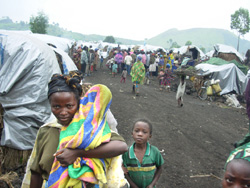
Photo: Eddy Isango/IRIN 
IDPs in Mugunga camp, west of Goma, capital of North Kivu Province
"We fled our house because [armed groups] were attacking and raping people and looting property," said Gina Kavira, 38, who fled with her husband and eight children from the village of Bambou five months ago and who has been living with a host family in three cramped rooms in Vitshumbi on the shores of Lake Edward.
"There is not enough to eat here. I try and catch fish. Normally, I catch three in a day. I sell two and feed my family on the other," she told IRIN. "My children can't go to school because we can't afford school fees. I'd like to return home if there was peace and if I could afford the transport. All we want is peace. I don't know when we will be able to return."
The UN Refugee Agency (UNHCR) will build a new shelter on a 54-hectare site near the town of Rutshuru to alleviate congestion in other IDP camps. UNHCR senior field officer Marie-Antoinette Okimba said the camp will cater for an estimated 16,000 people.
The new camp at Nahanga is intended to relieve pressure on communities in the towns of Rutshuru and Kiwanja, which have hosted 65,000 IDPs since October 2007.
According to the UN Children's Fund (UNICEF), 70 percent of IDPs in North Kivu live with host families, while only 30 percent actually live in formal IDP camps.
Many displaced people are also occupying communal spaces, such as churches, village halls and classrooms.
"In the beginning it is very easy for host communities to look after newly-arrived IDPs, but after a few months it causes big problems," said Okimba. "To provide food and shelter after long periods becomes very difficult."
The ceasefire agreement, signed on 23 January in the North Kivu capital Goma, called for an immediate cessation of hostilities, disengagement of troops and the creation of a buffer zone.
Parties to the pact include the government and armed groups such as the National Congress for the Defence of the People (CNDP), headed by renegade general Laurent Nkunda, as well as traditional warriors of shifting alliances generically referred to as Mayi Mayi.
A Hutu-dominated armed group many of whose members fled Rwanda after the 1994 genocide, the Forces Démocratiques de Libération du Rwanda (FDLR), has also been party to the conflict in eastern DRC. However, it was not included in the January agreement because it is considered one of the foreign armed groups in DRC, which should be dealt with according to the provisions of a separate agreement signed in Nairobi in November 2007. Under this deal the FDLR should be disarmed and its members repatriated to Rwanda.
According to Venetia Holland, a civilian official of the UN Mission in Congo (MONUC), despite the nominal ceasefire agreement, incidents of extortion, sexual violence, lootings, abduction, forced labour, killings and even alleged massacres continue to be perpetrated by both elements believed to be members of FDLR and some signatories of the Goma accord.
Okimba said that some civilians had tried to return home only to become victims of the violence.
"In the beginning of March many IDPs in the Rutshuru region tried to return to their homes, but they are coming back to the safety of the camps saying that [troops loyal to Nkunda] are accusing them of aiding and helping other troops," she said.
Civilians have often been caught between rival forces and accused of complicity with the "opposition" by the various rival groups.
Around Rutshuru, the IDP camps of Kasasa and Nyongera, which cater for a combined population of 13,000, are heavily overcrowded, sparking fears of an imminent cholera outbreak.
Elinor Raikes, the Rapid Response Mechanism Coordinator with the International Rescue Committee, said: "The situation in the camps is very precarious. Both camps are completely saturated and unless a solution is found quickly then there's a very high risk of public health problems like cholera."
In Kasasa, 60 people share each latrine; a figure that is three times the recommended standard of 20 people per latrine, according to Raikes.
Commissions set up to outline the implementation modalities of the Goma deal, which are chaired by the government and include representatives from all the signatory armed groups, are expected to begin their work before the end of March.
Holland, however, said it is unlikely that the protection situation will improve significantly, or that there will be any mass return and reintegration of IDPs until civilians witness a real military withdrawal on the ground.
hh/jn/sr/am

Related articles
- • Peacekeepers, Congo Army to Resume Joint Fight Against Rwandan Rebels (January 28, 2016)
- • Political tensions 'running high' in DR Congo ahead of 2016 elections (October 7, 2015)
- • DRC Army Putting Pressure on FDLR (April 1, 2015)
- • Southern African Leaders to Meet in Zimbabwe (August 15, 2014)
- • Kerry Calls on Kabila to Honor Constitution (May 4, 2014)
- • Security Council extends UN mission, intervention force in DR Congo for one year (March 28, 2014)
- • Bosco Ntaganda Attacked Civilians on Ethnic Grounds, ICC Prosecutor Says (February 10, 2014)
- • Congo Will Not Sign a 'Peace Deal' With Defeated M23 Rebels, Government Says (November 6, 2013)
- • Kabila Congratulates Congo Army for Defeating M23 Rebels (October 30, 2013)
- • Advancing Congo Troops Take Control of Rumangabo From M23 Rebels (October 28, 2013)
- • Congo Army Liberates Rutshuru, Kiwanja and Kibumba From M23 Rebels (October 27, 2013)
- • Congo Army Dislodges M23 Rebels From Strategic Town of Kibumba (October 26, 2013)
- • Congo Army Takes Control of Kibumba After Fighting With M23 Rebels Resumes (October 25, 2013)
- • U.S. Sanctions Rwanda Over Use of Child Soldiers by M23 Rebels (October 4, 2013)
- • Dozens of M23 Rebels Killed by Congo Army in Renewed Fighting (August 22, 2013)
- • M23 Arrests 110 People Accusing Rebels of Looting At Rally (July 27, 2013)
- • DR Congo Asks Rwanda to Turn Over M23 Rebel Leaders (July 26, 2013)
- • UN Security Council debate focuses on peace efforts for Africa's Great Lakes region (July 25, 2013)
- • M23 Rebels Kill, Rape Civilians in Eastern Congo: Human Rights Watch (July 22, 2013)
- • M23 Rebels in Disarray in Eastern Congo, Says Government Spokesman (July 19, 2013)
- • Bosco Ntaganda in the International Criminal Court's custody (March 22, 2013)
- • Warlord Bosco Ntaganda Turns Himself In at US Embassy in Rwanda (March 18, 2013)
- • U.S. Sanctions M23 Rebel Leaders (December 18, 2012)
- • The M23 Rebels Want to Overthrow Kabila? Nonsense (November 28, 2012)
- • Thousands of Women March Against M23 Rebels in Kinshasa (November 24, 2012)
- • U.S. Treasury Department Sanctions M23 Rebel Leader (November 13, 2012)
- • M23 Rebels Committing War Crimes (September 11, 2012)
- • DR Congo, Rwanda Sign Pact to Fight Rebels in Eastern Congo (July 15, 2012)
- • Kagame Is A Problem for The U.S. and The U.K. (June 23, 2012)
- • US blocking UN report on Ntaganda rebels, Human Rights Watch says (June 21, 2012)
Tags: |