

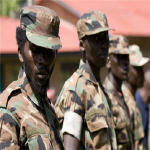
A report by a group of experts monitoring UN sanctions on the Democratic Republic of Congo has implicated former CNDP soldiers, now part of the Congolese Armed Forces (FARDC), in the illegal exploitation of mineral resources in eastern Congo.
The CNDP has been integrated in the FARDC (at least officially), following a peace accord signed in 2009 and a rapprochement between the Congolese and Rwandan governments.
The report says that “units of the former Congrès national pour la défense du peuple (CNDP) in FARDC have gained military control over most of the strategic areas rich in natural resources in the Kivus, presenting a challenge to their integration into FARDC. ”
Excerpts from the report:
Challenges for the integration of armed groups
152. Former CNDP officers within FARDC have deployed their mixed units throughout most territories of North and South Kivu. According to FARDC sources, former CNDP officers have convened meetings in order to bypass approved channels in making decisions on troop deployments. The Group received testimony from a number of FARDC officers that former CNDP officers, even when posted as deputy commanders in FARDC units, are the real decision makers within most FARDC brigades.
153. After rumours of his imminent suspension from FARDC circulated in September, General Bosco Ntaganda remained deputy commander of Amani Leo operations. Although his role has never been officially acknowledged by FARDC, Ntaganda publicly confirmed it in a Reuters interview published on 6 October.
Links to armed groups
163. Another challenge to the CNDP integration process has been the collaboration of certain former CNDP officers with armed groups. MONUSCO debriefings with former combatants repatriated to Rwanda indicate communication and collaboration between certain elements within CNDP and FDLR in 2010 (see paras. 87 and 88).
164. In addition, according to credible testimony from various sources, former CNDP officers have been in contact with Rwandan political dissidents in South Africa, including Patrick Karegeye, the former head of Rwandan intelligence, and Lieutenant General Faustin Kayumba Nyamwasa, who survived an assassination attempt in June 2010 in Johannesburg. The Group directly witnessed a conversation between Karegeye and former CNDP FARDC officers in the eastern part of the Democratic Republic of the Congo in September. According to United Nations sources and combatants interviewed by the Group, Kayumba may have sent an emissary to meet with FDLR, FPLC and Mai Mai leaders in the Democratic Republic of the Congo in February.
Illegal exploitation of natural resources
173. The Group conducted numerous interviews with former combatants and visited several mining areas in North and South Kivu Provinces. A key finding of the Group from this research is that while FARDC military operations have driven many Congolese and foreign armed groups out of the principal mining areas, these groups nonetheless continue to control hundreds of more remote mining deposits. In addition, the Group has established that armed groups have increased their use of intermediaries to invest and purchase minerals in mines that they can no longer access. The Group has further noted an increase in pillaging and looting attacks by armed groups on mineral traders or transporters. The Group estimates that most minerals find their way onto legal markets through countries in the region. Finally, the Group has documented the financial benefits that armed groups continue to receive from natural resources other than minerals, such as land, timber, fishing, poaching and charcoal.
174. In early September, President Kabila publicly denounced the “kind of mafia” he said had become involved in mining, and called upon them to set aside either their mining interests or their uniforms. In a subsequent public statement, the Minister of Mines referred to “the manifest involvement of certain local, provincial, and national authorities, both civilian and military, in the illegal exploitation and illicit trade of mineral substances” (see annex 19). The need to rid the mineral trade of such criminal networks is the official justification for the Government’s temporary freeze on mining activities in the three eastern provinces of South Kivu, North Kivu and Maniema as from 11 September 2010.
175. The Group’s research strongly supports the analysis of the President and the Minister of Mines, and some aspects of the complex, illegal involvement of these networks in the exploitation of natural resources are documented in this section. The Group considers that the cases, locations and individuals included illustrate the militarization of natural resources and its negative impact on security, human rights and the stabilization of the eastern part of the Democratic Republic of the Congo.
176. The involvement of FARDC in mining and the mineral trade is illegal for several reasons. Article 27 of the Mining Code prohibits public servants, including members of the armed forces, from involvement in mining (see annex 20). In addition, President Kabila, who is the FARDC supreme commander, and several senior FARDC officers have ordered the military to keep out of mining (see S/2010/252, annex II), and articles 63 to 65 and 113 of the military penal code of the Democratic Republic of the Congo prohibit looting and the violation of orders in the presence of the enemy or during wartime or under exceptional circumstances (see annex 21). Yet while some military prosecutors have sought to apply this law, in practice they face serious obstacles, including limited logistical resources and obstruction by superior officers.
177. The conflict between the economic interests of criminal networks within FARDC and the security mandate of the army has led to three critical negative consequences:
(a) Failure on the part of FARDC to prioritize the protection of civilians; (b) Competing chains of command and insubordination within FARDC; (c) Distraction from the pursuit of military operations against armed groups, leading to cohabitation and in some cases active collusion with those same groups.
On the web: Congo News Agency

Related articles
- • 'Deadly environment' plus 'political and social' obstacles hinder Ebola fight, Security Council hears (July 24, 2019)
- • Ebola outbreak declared an international Public Health Emergency (July 17, 2019)
- • Constitutional Court Declares Tshisekedi Winner of Presidential Election (January 19, 2019)
- • At least 30 dead after massacres in Ituri (March 2, 2018)
- • Peacekeepers, Congo Army to Resume Joint Fight Against Rwandan Rebels (January 28, 2016)
- • DR Congo Scores High on Growth, Lags in Poverty Reduction: IMF (October 13, 2015)
- • Political tensions 'running high' in DR Congo ahead of 2016 elections (October 7, 2015)
- • UN Report Blames Ugandan Islamists for 237 Killings in DR Congo (May 14, 2015)
- • DRC Army Putting Pressure on FDLR (April 1, 2015)
- • ICC Confirms 14-Year Sentence Against Thomas Lubanga (December 1, 2014)
- • ICC Case Against Bemba Wrapping Up as Another Opens (November 12, 2014)
- • Denis Mukwege Wins Sakharov Prize 2014 (October 21, 2014)
- • Violence in North Kivu Kills 21, Mostly Women, Children (October 18, 2014)
- • Southern African Leaders to Meet in Zimbabwe (August 15, 2014)
- • Congo Improves Natural Resources Accounting (July 4, 2014)
- • ICC confirms war crimes charges against Bosco Ntaganda (June 10, 2014)
- • Senior UN officials urge Brazzaville to halt expulsion of DR Congo nationals (May 26, 2014)
- • Kerry Calls on Kabila to Honor Constitution (May 4, 2014)
- • Security Council extends UN mission, intervention force in DR Congo for one year (March 28, 2014)
- • Death toll in Lake Albert boat accident rises to 251 (March 27, 2014)
- • Death toll in Lake Albert boat accident rises to 108 people (March 24, 2014)
- • Bosco Ntaganda Attacked Civilians on Ethnic Grounds, ICC Prosecutor Says (February 10, 2014)
- • New DR Congo amnesty law welcomed by UN envoys (February 5, 2014)
- • Colonel Mamadou Ndala Is Killed in Ambush (January 2, 2014)
- • DR Congo, M23 Rebels Sign Declarations Marking End of Kampala Peace Talks (December 12, 2013)
- • No 'Peace Deal' With Defeated M23 Rebels, DR Congo Says (November 11, 2013)
- • Congo Will Not Sign a 'Peace Deal' With Defeated M23 Rebels, Government Says (November 6, 2013)
- • Congo Army Takes Control of Mbuzi Hill From M23 Rebels (November 4, 2013)
- • Kabila Congratulates Congo Army for Defeating M23 Rebels (October 30, 2013)
- • Advancing Congo Troops Take Control of Rumangabo From M23 Rebels (October 28, 2013)